


Sino-Portuguese Architecture and Peranakan Heritage in Phuket Old Town
Phuket Old Town is often introduced through its colourful facades, but the streets reward a slower reading. Decorative plasterwork, shuttered windows, five-foot ways and deep shophouses are traces of an island shaped by trade, labour and migration. They are also part of a living neighbourhood, not a backdrop built for photographs.
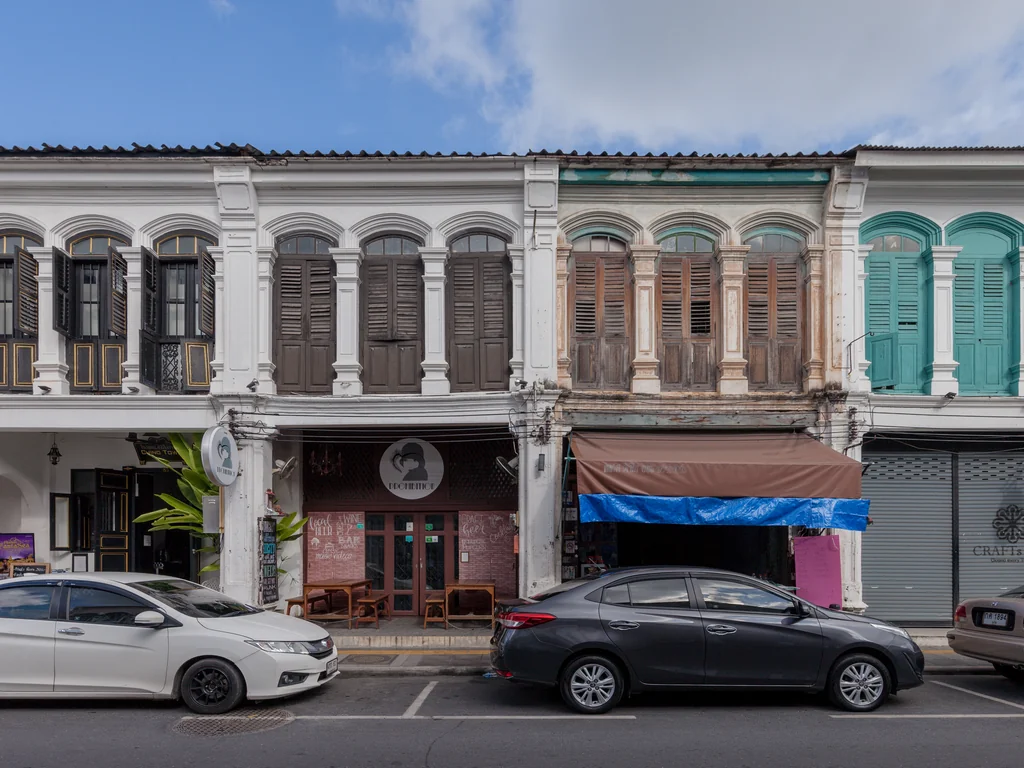
The phrase Sino-Portuguese architecture Phuket Old Town is useful, as long as it does not flatten a complicated history into a single label. The town developed through connections between southern Chinese communities, local Thai people, Malay Muslims, Indian traders and Europeans, among others. Tin mining and commercial exchange brought capital and people to Phuket. Families built homes, businesses, shrines, schools and social networks here. The resulting streetscape is one visible part of that shared past.
For visitors, this context changes the experience. Instead of looking only for the brightest wall, notice how a building meets the pavement, where a family house begins behind a shopfront, and how food, dress and festival traditions carry Peranakan heritage into the present.
Phuket sat within long-established maritime routes across the Andaman Sea and the Malay Peninsula. Its tin deposits made the island economically important, particularly as mining expanded and trade attracted workers and merchants. Phuket’s official history notes the prominent role of people of Chinese origin in mining and in the rubber-latex trade. That does not mean one community alone created the town. Commercial life depended on relationships across cultures, languages and occupations.
Chinese migrants, many with Hokkien roots, formed families and communities in Phuket over generations. Their descendants are commonly associated with Baba and Nyonya, or Peranakan, culture. The terms can carry different meanings across Southeast Asia and within individual families, so they should not be used as a costume label for every person of Chinese heritage. In Phuket, Peranakan heritage is better understood as a local cultural formation: family histories, foodways, language, ceremonies, dress and community institutions shaped by life between Chinese, Malay and Thai worlds.
Tin wealth helped finance more permanent urban buildings. Merchants and mine-related families needed premises that could face the street, hold stock, receive clients and accommodate domestic life beyond the public frontage. Streets such as Thalang, Dibuk, Krabi and Yaowarat preserve parts of that commercial pattern. Their buildings were practical as well as expressive. A facade could signal prosperity, while a shaded covered walkway gave pedestrians some relief from sun and rain.
A respectful account also leaves room for the hard parts. Mining relied on demanding work, and economic opportunity was unevenly distributed. Old Town heritage belongs to residents and families with different experiences of change, not only to the grand houses that remain easiest to admire.
Sino-Portuguese is the popular shorthand for a mixed architectural vocabulary seen in Phuket and parts of the wider Straits region. It does not mean every building was designed by Portuguese people, nor that each detail can be assigned to one origin. The label points to a blend of Chinese building traditions with European-influenced decorative forms that travelled through port cities and colonial-era networks.
On a walk through Old Town, look first at proportions. Many shophouses are narrow at the street and extend far back into the plot. Their front rooms opened to commerce, while inner rooms and courtyards supported household life, light and airflow. The covered pavement at the front, often called a five-foot way, creates a continuous pedestrian edge when neighbouring buildings align. It shows that these streets were made for daily movement and trade, not only for passing vehicles.
Then look up. You may see pilasters, arches, stucco swags, floral reliefs, coloured tiles, louvred shutters and ventilating openings above doors. Chinese characters, auspicious motifs and family references may appear beside European-style moulding. The mix reflects local choices, imported materials and ideas adapted to Phuket’s tropical climate.
Not every older building in Phuket fits this pattern. The provincial government distinguishes folk, Chinese and mixed Sino-Portuguese architecture. That keeps the town’s story broader than one photogenic facade. A Chinese shrine, a modest residence and a grand mansion can each reveal different social histories.
A good heritage walk begins with observation rather than a checklist. Start on Thalang Road and move into nearby lanes at an unhurried pace. Notice the rhythm of doors and windows, the depth of covered walkways, small businesses operating beneath old ornament and the contrast between restored and weathered surfaces. Soi Romanee is well known for its narrow, colourful row of buildings, but it makes more sense as part of the surrounding street network than as an isolated stop.
Krabi Road offers a different scale. Larger historic residences help explain how domestic life and social status could sit behind the commercial town. Chinpracha House is a useful example. Phuket Province describes it as a Sino-Portuguese house built more than a century ago and preserved as a living museum. Its central open roof, internal well, original objects and imported decorative elements make it more revealing than an exterior-only visit.
When entering a heritage building, follow the house rules, ask before photographing people and avoid treating private homes or active businesses as sets. A doorway may be someone’s workplace, family property or sacred threshold. Keeping passageways clear and buying from small businesses when appropriate are simple ways to make a visit less extractive.
Museums can turn architectural details into a fuller story. Phuket Thai Hua Museum, on Krabi Road, is a helpful first stop because the former Chinese school building and its exhibitions introduce Chinese and Peranakan history in Phuket. It gives visitors a clearer sense of the communities behind the streetscape before they explore it on foot.
Chinpracha House offers a close view of a preserved residence. Its rooms, furnishings and courtyard arrangement provide a more domestic perspective than a shophouse facade can. Check directly with each venue for current opening hours, admission conditions and photography rules, as these can change.
For the mining chapter, the provincial Tin Mining Monument at Saphan Hin is a modest but meaningful stop. Phuket Province says it commemorates the arrival of the first tin dredge in 1909 and was established in 1969. It is a reminder that the wealth expressed in Old Town’s architecture came from an industry beyond the town centre.
Architecture gives Peranakan heritage a visible frame, but the culture cannot be reduced to paint colours, tiles or a decorative theme. Food is often the most accessible entry point. Phuket’s local cooking reflects Hokkien Chinese, Malay and southern Thai influences, with familiar dishes taking distinct local forms. Look for places that explain their recipes or have a clear connection to the neighbourhood, rather than assuming every dish marketed as “Peranakan” represents the same tradition.
Traditional dress is another important expression. You may encounter the colourful kebaya associated with Nyonya style, often paired with a sarong and elaborate jewellery for formal or celebratory occasions. It deserves more than a quick costume photo. Clothing can carry family memory, craft knowledge, religious practice and ideas of occasion. If you attend a cultural event, follow the organiser’s guidance and ask permission before taking close portraits.
Shrines and festivals show that heritage is active. Phuket’s official information links the island’s Chinese influence to its many shrines and the annual Vegetarian Festival. Visitors are welcome to learn, but ceremonies are not performances on demand. Dress appropriately, respect restricted spaces, keep noise low and do not obstruct participants or worshippers for a camera angle.
The same care applies to language. “Baba Nyonya” and “Peranakan” are terms with local and regional histories. Use the names people and institutions use for themselves, and be prepared to listen rather than categorise. That approach is more valuable than memorising a list of architectural features.
Begin at a museum, walk the surrounding streets and pause for a locally rooted meal or drink. Early morning or late afternoon is generally more comfortable for walking, but the best time is the one that allows you to move without rushing residents and businesses.
Restoration can protect a building, yet an old facade alone does not guarantee that its history is being shared accurately. Read museum panels, look for attribution, support longstanding local operators where possible and accept that some stories will remain private.
For a base close to the town centre, Bhukitta Boutique Hotel places guests near Phuket Old Town. Its own guide, Stay in Style: Bhukitta Boutique Hotel Phuket, is a practical companion for planning time around the area’s streets, cafés and cultural sights.
The name describes a mixed architectural language, combining Chinese traditions with European-influenced forms that circulated through regional trading ports. It is a useful general term, but it should not be read as proof that every Old Town building has the same origin or designer.
Tin mining brought investment, labour and commercial connections to Phuket. It helped create the conditions in which trading families and businesses built the shophouses, residences, shrines and institutions that shaped the town.
Phuket Thai Hua Museum and Chinpracha House are useful starting points in Old Town. They provide context that is hard to get from a street walk alone. Confirm current visitor information directly before going.
Ask first, especially during ceremonies, family occasions or in active places of worship. Respect any signs, staff guidance and areas set aside for participants.
Phuket Old Town becomes more interesting when you see its architecture as evidence of connected lives. The shophouses and mansions are part of a continuing cultural landscape shaped by work, migration, family and faith. Walk slowly, learn from local institutions and leave space for the neighbourhood to remain itself.
Plan a considered Old Town stay with Bhukitta Boutique Hotel, then use the town’s museums and streets to explore beyond the facade.
รับส่วนลดห้องพักเพิ่มสูงสุด 5% สำหรับสมาชิก
แจ้งล่วงหน้าอย่างน้อย 3 วัน ก่อนวันเข้าพัก ในช่วงวันที่ 1 พฤษภาคม – 31 ตุลาคม เท่านั้น
รับส่วนลด 10% สำหรับค่าอาหารและเครื่องดื่มภายในโรงแรม
รับส่วนลด 10% สำหรับสินค้าของที่ระลึกภายในโรงแรม